

One of the core principles of my teaching philosophy is being able to cultivate student engagement. Although traditional lectures are useful for presenting information, they can become tedious very quickly. To mitigate this issue, I intersperse active learning techniques that involve students in the learning process. I regularly stop to discuss important, difficult, or controversial concepts with the class, which not only provides students a chance to reflect over the material but also an opportunity to develop scientific rationale. Students are further engaged when they see examples of how science affects and enriches their lives beyond the classroom, so I purposefully design my lectures to include real-world applications.
Students who are engaged in the course material are ready to learn, but it is equally important to ensure that students are given the same opportunities to learn. Classrooms are diverse microcosms full of individuals with different interests, educational backgrounds, cultural upbringings, and life experiences. Thus, I value curriculum design decisions that highlight a universal design for learning. My course materials provide students multiple ways to acquire information and demonstrate what they have learned. Lecture notes and supplemental resources are made available in class and online when possible via the university LMS. Additionally, assessments include multiple-choice, short-answer, and matching questions. Students do not all learn the same way, but I believe that it is my responsibility to provide them with equal opportunities to learn.
Facilitating student collaboration is another essential aspect to the learning process. Collaborative learning is valuable for students because it promotes teamwork and communication skills. Inter-student collaboration fosters relationships that may benefit the student in future endeavors. I enjoy discussing challenging concepts with my students as a method of increasing student engagement, but in larger classes, I find that it is advantageous to pair students up to contribute to the discussion in groups. Being able to communicate scientific concepts eloquently and rationally is a crucial skill in the modern era. One of the core benefits of collaborative work is creating an intellectually rewarding environment in which students with different skills and knowledge come together to engage in shared learning.
Ultimately, I believe learning is a lifelong process for everyone, including teachers. I am always seeking new professional development opportunities to improve my courses and myself for my students. Learning is not something that ends with the semester, but rather, a constant series of personal and professional growth that goes far beyond my classroom. My goal is to enrich students’ lives with scientific knowledge and lifelong skills, like critical thinking and communication, through engagement, accessibility, and collaboration. I continually look forward to teaching and learning from the exceptional students at Florida Southern College.
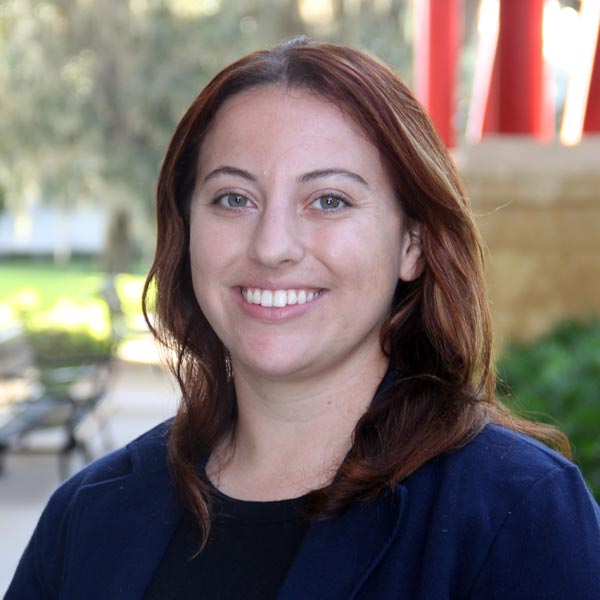
Originally from south Florida, Katherine Upshaw grew up with an intense interest in animal biology and has fostered that passion throughout her professional career as well as in her personal life.
She graduated from the University of Florida in 2018 with a bachelor’s degree in animal science and a minor in business administration. At the University of Florida, Katherine developed her enthusiasm for animal biology through various veterinary technician jobs as well as involvement in the Equestrian Team, Pre-Veterinary Club, Block & Bridle club, and a veterinary internship in France. Throughout her undergraduate career, Katherine discovered a love for genetics and biological research via a variety of genetics courses (from livestock genetic improvement to human molecular genetics) and was fortunate to join a research lab that focused on the genetic response of C. elegans to environmental stress.
Katherine furthered her research interests at Kansas State University, where she earned a master’s degree in animal breeding and genetics under Dr. Megan Rolf in addition to a graduate certificate in genetics, genomics, and biotechnology. Katherine’s research interests include the prevalence and possible causal variants of gene disorders in vertebrates. Now at Florida Southern College, Katherine strives to make a difference in her students’ lives by enriching their understanding of biology and how it relates to everyday life.