

Skip to main content Skip to main navigation Skip to footer content

Roberts Center for Learning and Literacy

The Roberts Center for Learning and Literacy provides specialized instruction in the early diagnosis and intervention of learning and literacy challenges, supporting children who face dyslexia and other learning differences.

On A Mission

For many children, learning to read is an enjoyable, even thrilling adventure; they put the pieces together without seeming to regard the teaching approach used. For others, the experience can be intimidating and exasperating. And although eager parents and teachers try everything they can to help, their efforts fall short. Addressing the frustration experienced by otherwise bright children who have difficulty with reading and other academic pursuits is one of the main purposes of the Roberts Center for Learning and Literacy.

Research on early literacy is vast and often contradictory, but on one point it agrees: the importance of early diagnosis and intervention. That conviction is the driving force behind the Roberts Center, which exists to give Florida Southern students, area teachers and parents, and other community members access to the best research and most effective strategies to help discouraged young readers and writers succeed.

Through an annual lecture series and ongoing partnerships with area school systems, the Center works to identify and fill the gaps in meeting the needs of bright children experiencing dyslexia and related learning differences. Its aim is to become a regional clearinghouse for parents and teachers on dyslexia, while providing direct services to children who struggle with reading-related challenges.

Our History

In September 2006, Florida Southern College President Anne Kerr announced the establishment of the Roberts Center for Learning and Literacy, made possible through a gift from longtime Lakeland residents Hal and Marjorie Roberts. At the announcement, Dr. Kerr said the Center would have "a far-reaching, positive impact on the reading and learning skills of our local school children," with Florida Southern students receiving specialized instruction in identifying and addressing learning needs through both coursework and a series of annual lectures by nationally renowned educators in learning and literacy.

With those words, the inaugural season of the Roberts Center Distinguished Lecture Series began. Carol Kranowitz, author of The Out-of-Sync Child, presented a morning lecture to faculty and students and an evening lecture to area teachers and the public on October 25, 2006.

The Roberts family has been actively involved in supporting educational excellence for many years. The Robertses have three children who graduated from Florida Southern College, and Mrs. Roberts serves on the College's Board of Trustees.

"Between kindergarten and third grade, children learn to read so that for the rest of their lives they can read to learn."

Marjorie Roberts Trustee and Donor

Programs for Children and Families

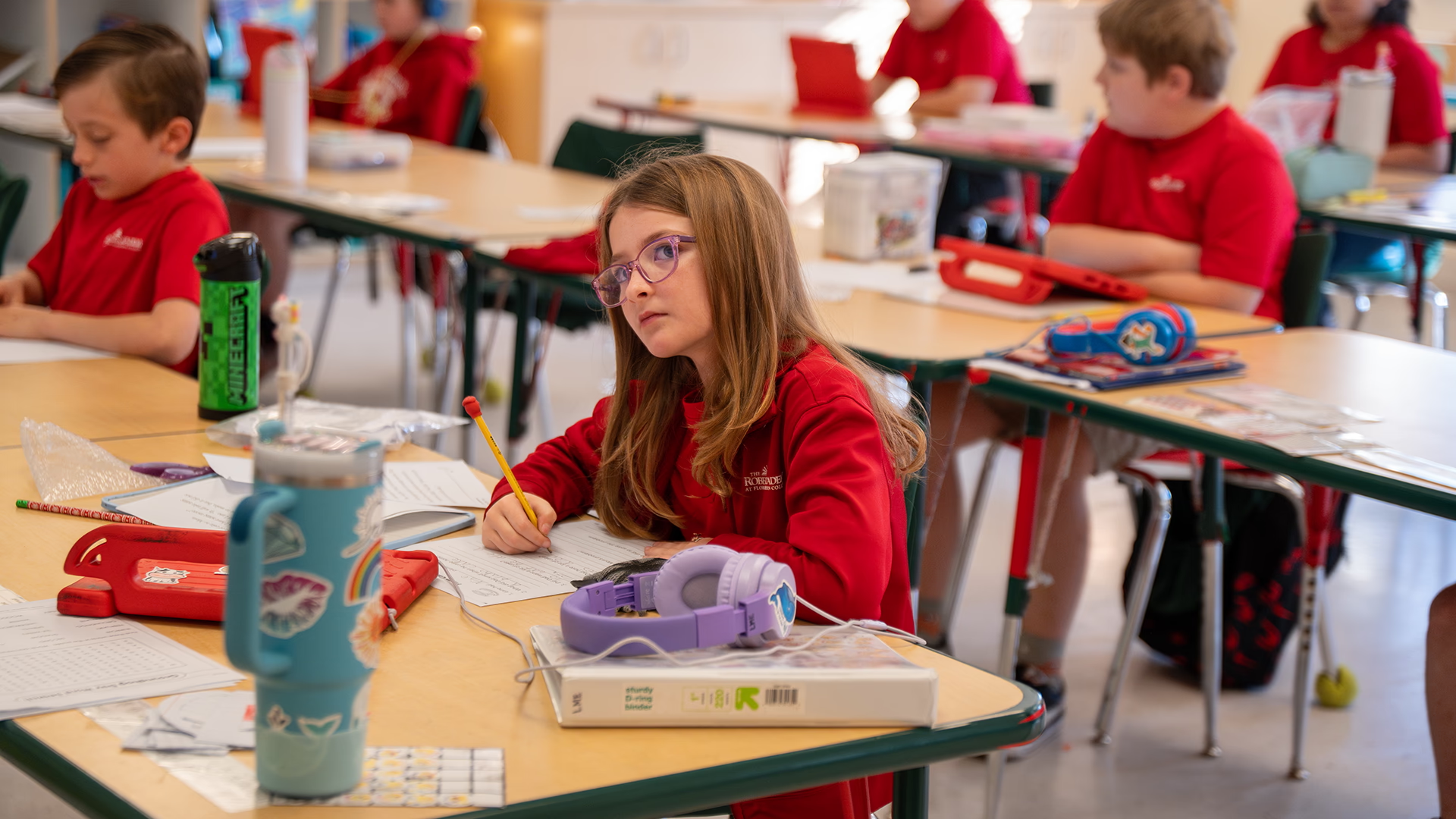
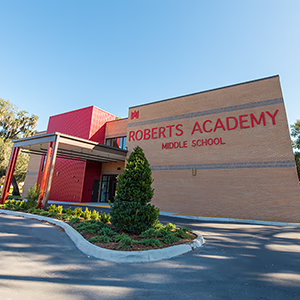
The Roberts Center connects children who struggle with reading to specialized, research-based instruction in a supportive setting. Whether your child needs focused one-on-one help during the school year or an immersive experience over the summer, our programs meet young readers where they are and build the skills and confidence to move forward. Registration is managed by The Roberts Academy.

Reading Clinic

The Roberts Center Reading Clinic offers one-on-one tutoring for children who struggle with reading, whether or not they have been formally diagnosed with dyslexia. Tutors are trained professional teachers who use Orton-Gillingham and other research-based, multi-sensory methods tailored to each child's learning style.
Summer Reading Camp

Each summer, The Roberts Academy hosts a Summer Reading Camp offering intensive, small-group reading instruction paired with hands-on STEAM activities for children in a supportive, engaging environment. Weekly sessions fill quickly, and space is limited to keep class sizes small.

Resources

  • Eide, Brock and Fernette. The Mislabeled Child: How Understanding Your Child's Unique Learning Style Can Open the Door to Success. New York: Hyperion Press, 2006. A significant step forward toward rethinking our understanding of struggling children. Enables us to customize education and parenting for children whose minds work differently from most. (Levine)
  • Hymer, Jaydra. Turn Your Child's ADHD Stress into Success! Utah: RARE Interactions, Inc, 2007. An identification of how to minimize the more than 30 physical/chemical contributors to ADHD -without drugs.
  • Kranowitz, Carol. The Out-of-Sync Child: Recognizing and Coping with Sensory Processing Disorders. New York: Perigee Books, 2006. A personal sharing of fun, successful techniques which have been utilized with children of all ages who are experiencing difficulties with sensory processing.
  • Lavoie, Richard. How Difficult Can This Be? (PBS video) 1996. A dynamic videotaped exercise in which parents, educators, psychologists and children are led through a series of exercises designed to enable participants to ‘walk a mile’ in the shoes of someone with learning disabilities and other learning differences.
  • Lavoie, Richard. It’s So Much Work to be Your Friend. (PBS video) 2005. Explores the causes and consequences of the social incompetence experienced so frequently by children with learning disabilities and other learning differences.
  • Levine, Mel . A Mind at a Time. New York: Simon and Schuster, 2002. A wide-ranging exploration of the countless ways in which children’s minds differ, coupled with workable recommendations on what parents and professionals can do to help them develop to the fullest.
  • Miller, Lucy Jane. Sensational Kids: Hope and Help for Children with Sensory Processing Disorder. New York: Perigee Books, 2006. A dynamic sharing of a lifetime of study and vivid stories which teach parents and others the signs and symptoms of SPD.
  • Probst, Barbara. When The Labels Don't Fit. New York: Three Rivers Press, 2008. Instead of viewing every difficulty or difference as a disorder, the author provides a new model for understanding and addressing the "specific traits" that lie behind a child's behavior.

  • Baglio, B. (2001). Dolphin Diaries: Chasing theDream. New York: Scholastic.
  • Baglio, B.M. (2000).Dolphin Diaries no. 4: Under theStars. New York: Scholastic.
  • Banks, J.T. (1995). Egg‐Drop Blues. New York:Houghton Mifflin.
  • Barrie, B. (1994). Adam Zigzag. New York: DelacortePress.
  • Beckhorn, S.W. (2003). Sarey by Lantern Light.Camden, ME: Down East Books.
  • Betancourt, J. (1993). My Name is Brian, Brian. NewYork: Scholastic.
  • Betancourt, J. (1994). I Want a Pony. New York:Scholastic.
  • Betancourt, J. (1995). Give Me Back My Pony. NewYork: Scholastic.
  • Betancourt, J. (1995). A Pony for Keeps. New York:Scholastic.
  • Betancourt, J. (1995). Pony in Trouble. New York:Scholastic.
  • Betancourt, J. (1995). Pony to the Rescue. New York:Scholastic.
  • Betancourt, J. (1995). Runaway Pony. New York:Scholastic.
  • Betancourt, J. (1995). Too Many Ponies. New York:Scholastic.
  • Betancourt, J. (1996). The Baby Pony (Pony PalsSuper Special, 1). New York: Scholastic.
  • Betancourt, J. (1996). Circus Pony. New York:Scholastic.
  • Betancourt, J. (1996). Don’t Hurt My Pony. New York:Scholastic.
  • Betancourt, J. (1996). Good‐bye Pony. New York:Scholastic.
  • Betancourt, J. (1996). The Wild Pony.New York:Scholastic.
  • Betancourt, J. (1997). The Blind Pony. New York:Scholastic.
  • Betancourt, J. (1997). The Ghost Pony (Pony PalsSuper Special, 3). New York: Scholastic.
  • Betancourt, J. (1997). The Girl Who Hated Ponies.New York: Scholastic.
  • Betancourt, J. (1997). The Missing Pony Pal. NewYork: Scholastic.
  • Betancourt, J. (1997). Pony Sitters. New York:Scholastic.
  • Betancourt, J. (1997). The Story of Our Ponies (PonyPals Super Special, 2). New York: Scholastic.
  • Betancourt, J. (1998). Detective Pony. New York:Scholastic.
  • Betancourt, J. (1999). Moving Pony. New York:Scholastic.
  • Betancourt, J. (1999). Pony and the Bear. New York:Scholastic.
  • Betancourt, J. (1998). The Saddest Pony. New York:Scholastic.
  • Betancourt, J. (1999). Stolen Ponies. New York:Scholastic.
  • Betancourt, J. (1999). Western Pony. New York:Scholastic.
  • Betancourt, J. (1999). The Winning Pony. New York:Scholastic.
  • Betancourt, J. (2000). Lonely Pony. New York:Scholastic.
  • Betancourt, J. (2000). Movie Star Pony. New York:Scholastic.
  • Betancourt, J. (2000). The Pony and the Missing Dog.New York: Scholastic.
  • Betancourt, J. (2000). Unlucky Pony. New York:Scholastic.
  • Betancourt, J. (2001). He’s My Pony. New York:Scholastic.
  • Betancourt, J. (2001). Lost and Found Pony. NewYork: Scholastic.
  • Betancourt, J. (2001). Newborn Pony. New York:Scholastic.
  • Betancourt, J. (2001). Ponies From the Past. NewYork: Scholastic.
  • Betancourt, J. (2001). Pony 4 Sale. New York:Scholastic.
  • Betancourt, J. (2001). What’s Wrong With My Pony? New York: Scholastic.
  • Betancourt, J. (2002). The Fourth Pony Pal (Pony PalsSuper Special, 4). New York: Scholastic.
  • Betancourt, J. (2002). Magic Pony. New York:Scholastic.
  • Betancourt, J. (2002). The Pony and the HauntedBarn. New York: Scholastic.
  • Betancourt, J. (2002). Pony and the Lost Swan. NewYork: Scholastic.
  • Betancourt, J. (2003). No Ponies in the House. NewYork: Scholastic.
  • Betancourt, J. (2003). Ponies on Parade. New York:Scholastic.
  • Betancourt, J. (2003). Pony Problem (Pony Pals SuperSpecial, 5). New York: Scholastic.
  • Draper, S. M. (2002). Double Dutch. New York:Atheneum Books for Young Readers.
  • Goodman, J. (1994). The Mystery of the Third Oak.
  • American Fork, UT: Covenant Communications.
  • Goodman, J. (1995). The Mystery at Haunted Ridge.
  • American Fork, UT: Covenant Communications.
  • Griffith, J. (1998). How Dyslexic Benny Became aStar: A Story of Hope for Dyslexic Children and TheirParents. Dallas, TX: York town Press.
  • Grimes, N. (2002). Bronx Masquerade. New York:Penguin Group.
  • Janover, C. (2000). How Many Days Until Tomorrow?Bethesda, MD: Woodbine House.
  • Janover, C. (2000). The Worst Speller in Junior High.
  • Lincoln, NE: Universe.com.
  • Konigsburg, E. L. (1998). Altogether, One at a Time.New York: Aladdin Paperbacks.
  • Lester, T. (1999). Welcome to Dyslexic Park. Fresno,CA: Poppy Lane.
  • Litchman, K. (1997). The Wrong Side of the Pattern.
  • Unionville, NY: Royal Fireworks Press.
  • Montes, M. (2003). Get Ready for Gabi! Book No. 2:Who’s That Girl? New York: Scholastic Press.
  • Oliver, D. (1994). McCracken’s Class No. 5: Tough luck, Ronnie. New York: Random House.
  • Polacco, P. (1998). Thank You, Mr. Falker. New York: Philomel Books.
  • Root, A. Gladden, L. (1995). Charlie’s Challenge.
  • Temple, TX: Printmaster Press.
  • Rorby, G. (1996). Dolphin Sky. New York: G. P.Putnam’s Sons.
  • Rue, N. (1998). Raise the Flag Series: I Only Binge onHoly Hungers. Colorado Springs, CO: WaterbrookPress.
  • Rue, N. (2002). Lily Series: Lights, Action, Lily! GrandRapids, MI: Zondervan.
  • Rue, N. (2003). Lily Series: Horse Crazy Lily. GrandRapids, MI: Zondervan.
  • Schares, S. J. (2000). Just Plain Crazy. Lincoln, NE:Writers Club Press.
  • Schlieper, A. (1995). The Best Fight. Morton Grover,IL: Albert Whitman.
  • Stern, R., Worcester, H. P. (2003). Beryl E. Bean No.3: Adventure Lonely Leader. New York: HarperCollinsChildren’s Books.
  • Winkler, H., Oliver, L. (2003). Hank Zipzer: Day of the Iguana. New York: Grosset Dunlap.
  • Winkler, H. Oliver, L. (2003). Hank Zipzer: I Got a“D” in Salami. New York: Grosset Dunlap.
  • Winkler, H. Oliver, L. (2003). Hank Zipzer: Niagara Falls or Does It? New York: Grosset Dunlap.

Other Initiatives and Projects

Over the years, the Roberts Center has supported a range of literacy initiatives in partnership with the College, local schools, and community funders.

The Center has provided professional development opportunities for Florida Southern education students, including support for attending national training in learning and literacy through the All Kinds of Minds program.

In partnership with Polk County Public Schools and a Verizon grant, the Center operated the Dream Literacy Project, a tutoring program that paired trained Florida Southern students with elementary readers at area schools to strengthen early literacy skills.


Leadership and Governance

The Roberts Academy Head of School oversees the work and mission of the Roberts Center for Learning and Literacy, assisted by the following members of the Advisory Council:

  • Drs. Hal and Marjorie Roberts, Founders
  • Mrs. Melissa Anderson
  • Dr. Roxanne Back, Associate Provost for Academic Affairs, Florida Southern College
  • Dr. Pamela Craven
  • Mrs. Anna Maria DiCesara
  • Dr. Jill Freedman, Head of School, The Roberts Academy at Florida Southern College
  • Mrs. Lori Garrard
  • Dr. Victoria Giordano, Associate Provost for Institutional Research and Assessment, Florida Southern College
  • Dr. Hope Holley
  • Mrs. Mandy Hurtt
  • Dr. Anne Kerr, President Emeritus, Florida Southern College
  • Mrs. Tiffany Kilpatrick
  • Mrs. Michelle Lindsay
  • Mrs. Jennifer Miller
  • Dr. Lori Rakes,  Dean of the School of Education, Florida Southern College
  • Mrs. Mandy Sanders
  • Mrs. Judy Senzamici
  • Mrs. Amy Smith
  • Dr. Tracey Tedder, Executive Vice President for Academic Affairs and Provost
  • Mrs. Laura Tomlinson
  • Mrs. Brooke Veal